
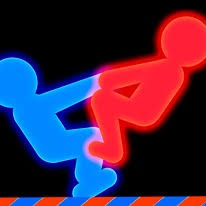


On Top
Get On Top is a local two-player physics game where you push, pull, jump, and shift your weight to force your opponent’s head onto the floor and reach 11 points first.
On Top is a two-player physics fighting game where two characters are locked together and each player tries to force the other character’s head onto the floor. There are no weapons, health bars, or complicated attack combinations. Most of the challenge comes from shifting your character’s weight, jumping at the right moment, and using your opponent’s movement against them.
The rules take only a few seconds to understand, but the physics make each round unpredictable. Randomly holding movement keys usually causes more problems than it solves. Short movements and watching how both characters lean tends to give you much better control.
| Game Detail | Information |
|---|---|
| Game | On Top |
| Developer | Bennett Foddy |
| Genre | Fighting / Physics |
| Gameplay Style | Local two-player physics wrestling |
| Player 1 Controls | WASD |
| Player 2 Controls | Arrow Keys |
| Supported Devices | Desktop |
| Poki Release | October 2019 |
| Latest Verified Poki Update | April 2021 |
| Current Rating | 4.3/5 |
| Current Votes | 223K+ |
| Multiplayer | Yes, local 2-player |
| Winning Score | First to 11 points |
The current browser listing credits Bennett Foddy as the developer, lists October 2019 as its Poki release, and April 2021 as the latest update. The rating currently sits around 4.3 from more than 223,000 votes, although that figure can change.
The Goal Is Simple
On Top does not ask you to memorize several attacks.
You and another player control two linked fighters. The objective is to shift, push, pull, and jump until the other character’s head touches the floor.
One point is awarded when that happens.
The first player to reach 11 points wins the match. Bennett Foddy’s own page confirms the first-to-11 format and describes the game as his take on Fight of the Sumo Hoppers.
You can read the developer’s original description on the official Bennett Foddy On Top page.
On Top Controls
Both players share one keyboard.
Player 1
- W: Move upward or jump
- A: Shift left
- S: Shift downward
- D: Shift right
Player 2
- Up Arrow: Move upward
- Left Arrow: Shift left
- Down Arrow: Shift downward
- Right Arrow: Shift right
The current Poki version lists WASD for Player 1 and the Arrow Keys for Player 2.
The MDN KeyboardEvent guide explains how browser games can recognize individual keyboard presses such as WASD and the arrow keys.
Why the Physics Matter
The characters do not move like normal fighting-game characters.
Their bodies lean, rotate, and react to momentum.
That means holding right does not always move you safely to the right. If both fighters are already leaning, the same input can cause your own character to rotate underneath the opponent.
The useful skill is understanding what the pair is already doing before adding another movement.
The basic idea connects closely with balance and center of mass. The OpenStax explanation of center of mass gives useful background on why shifting weight changes how connected objects move.
Getting Above Your Opponent
The title describes the main strategy.
You want your character positioned above the other player when both fighters begin falling.
Being higher usually gives you a better chance of forcing the opponent toward the floor.
But simply jumping constantly is not enough.
If your character is already leaning backward, another jump can make the position worse. Sometimes doing less and letting the other player overcommit gives you the stronger position.
Push, Pull, and Shift Your Weight
Most rounds are decided by small changes rather than one huge move.
You can:
- Lean into the opponent
- Pull backward
- Shift your weight upward
- Drop lower
- Jump to change the angle
Because the characters remain connected, one player’s movement directly affects the other.
That is what makes the game feel different from a standard fighting game.
First to 11 Points
Every head-to-floor contact ends the current round.
The score then increases and both characters reset for the next attempt.
The first player who reaches 11 wins the full match.
This format works well because one lucky movement does not decide everything.
You have enough rounds to notice what the other player keeps doing and adjust.
Do Not Hold Every Key
One of the easiest mistakes is pressing several keys for too long.
Because the physics respond continuously, long inputs can push the character much farther than expected.
Short taps usually give you more information.
Make a small movement.
Watch how the characters rotate.
Then decide what needs to happen next.
This is much easier to control than committing to one direction before you know the result.
Use the Other Player’s Momentum
You do not always need to overpower the other player.
Sometimes the stronger move is letting them create the movement for you.
If the opponent pushes aggressively while already leaning forward, changing your own weight at the right moment can make their momentum work against them.
This is one reason rounds rarely play exactly the same way twice.
The physics create different positions depending on the timing of both players.
Jumping at the Right Moment
Jumping is useful, but it can also leave your character unstable.
A good jump can move your body over the opponent.
A poorly timed jump can rotate your head toward the floor.
Before jumping, look at which character is currently higher and which direction the pair is rotating.
If your position is already strong, adding another movement may not be necessary.
Recovering From a Bad Position
Being underneath does not automatically mean the round is lost.
You can sometimes recover by shifting your weight before your head reaches the floor.
The key is avoiding panic.
Rapidly pressing every direction usually makes the physics harder to read.
Try one controlled correction and watch how the position changes.
That gives you a much better chance of understanding whether the recovery is working.
Sharing One Keyboard
Get On Top is designed around two players using the same desktop keyboard.
That makes it easy to start a local match because no additional controller or online account is required.
Player 1 uses the left side of the keyboard, while Player 2 uses the arrow-key area.
The W3C UI Events specification provides technical background on how browsers process keyboard and other interface events.
Is Get On Top Online Multiplayer?
No.
The verified version is primarily a local two-player game.
Both players use the same computer and keyboard rather than joining through an internet matchmaking system.
That makes it better suited to playing with someone beside you than searching for random online opponents.
Can You Play Get On Top Alone?
The Bennett Foddy and Poki versions are built around two-player competition.
The main experience therefore assumes you have another person using the second control set.
Some unrelated remakes on other sites may add computer-controlled modes, but those should not be confused with the verified Bennett Foddy version.
Get On Top on Mobile
The currently verified Poki edition lists desktop as its supported device.
That makes sense because both players depend on separate keyboard layouts.
Some later recreations advertise touchscreen controls, but those are not the same thing as the original Bennett Foddy browser edition.
For this page, desktop is the safest supported-device description.
Who Created Get On Top?
Get On Top was created by Bennett Foddy.
Foddy is known for designing games where very simple controls can create unusually difficult movement challenges.
His official Get On Top page says the game was inspired by Fight of the Sumo Hoppers and was originally designed to be controlled using two trampolines.
That unusual origin helps explain why the finished game relies so heavily on body movement, balance, and momentum rather than traditional fighting controls.
Get On Top Release History
The game existed before its current Poki edition.
Poki lists its own release as October 2019, with the latest update in April 2021.
Bennett Foddy’s official legacy page confirms the original game but does not provide a precise original release date.
For that reason, it is better to describe October 2019 specifically as the Poki release rather than claiming it was the first-ever release of Get On Top.
A Simple Way to Improve
Start by making smaller movements.
Do not immediately try to throw the opponent.
Watch how the two characters rotate when you press one direction.
Then learn what happens when you jump from different positions.
After a few rounds, start responding to the opponent instead of making the same movement every time.
The game becomes much easier to understand once you begin thinking about balance rather than button speed.
Get On Top vs Regular Fighting Games
Most fighting games revolve around attacks, blocks, special moves, and health.
Get On Top removes almost all of that.
Instead, the match depends on:
- Balance
- Momentum
- Position
- Timing
- Local multiplayer
- Physics
This makes it closer to a competitive physics challenge than a traditional combat game.
Games Like Get On Top
Players who enjoy Get On Top may also like other short local multiplayer games built around simple controls and unpredictable movement.
Rooftop Snipers is another two-player browser game where positioning and timing matter more than complicated controls.
Blumgi Paintball is a useful Prothots alternative for players who prefer colourful multiplayer competition with platform movement.
For a different physics-focused challenge, games built around ragdoll movement can provide a similar trial-and-error feeling.
Related Categories
Get On Top fits naturally into:
- 2 Player Games
- Fighting Games
- Physics Games
- Local Multiplayer Games
- Skill Games
- Desktop Games
- Casual Games
Its strongest identity is still local two-player physics competition because nearly every movement depends on both players affecting the same connected system.
About Get On Top
Get On Top takes an extremely small set of controls and turns them into a surprisingly competitive two-player game.
There are no long tutorials or complicated upgrades. You share a keyboard, move two connected characters, and try to force the other player’s head onto the floor before they do the same to you.
The first-to-11 scoring system gives you enough time to learn how your opponent plays, while the physics prevent every round from feeling identical.
The most useful approach is not pressing more buttons. It is learning when not to move, when to shift your weight, and when your opponent’s momentum has already created the opening you need.

Related products
Reviews
There are no reviews yet.