
Five Real Lessons On Building A Brand People Trust And Love

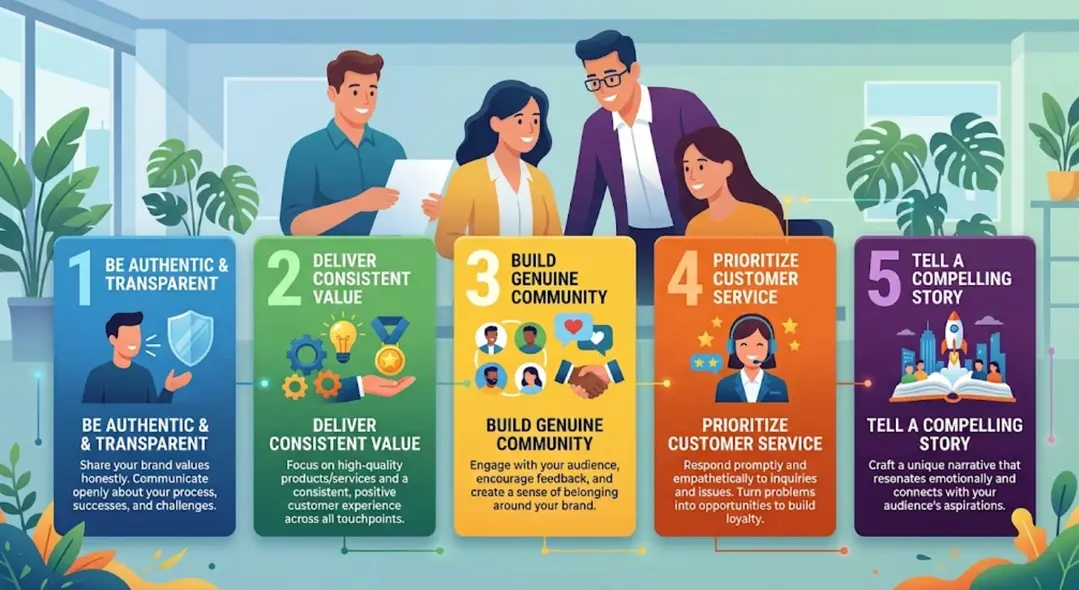
A brand becomes trusted and loved through five ordinary habits. keeping the small promises nobody wrote down, stating the awkward parts of your offer before a customer has to ask, putting named people in front of the logo, handling your failures in the open instead of over private email, and repeating all of that long enough that a stranger can predict what you will do next. None of those are campaigns. They are operating choices, and they cost far more in patience than in budget.
I learned each one the slow way. My first two years running a small services studio were spent doing what most owners do, which is treating branding as a visual problem. We changed the logo twice. We rewrote the tagline four times. Our repeat rate barely moved. What finally moved it was an unglamorous decision to stop quoting a turnaround time we could not hit. Nothing about that was creative work. It was arithmetic and a bit of nerve.
This piece is written for the owner or marketing lead who is weighing up whether to invest in brand work at all, and who wants to know what actually shifts the needle before they spend. I have kept the sales talk out of it. Where I have a number, I will point at whose number it is.
Here is the short version of the five lessons:
- Small promises carry more weight than large ones, because customers test them constantly
- Disclosure before the question is worth more than persuasion after it
- People trust people, and a logo is not a person
- How you behave after a failure is a stronger signal than how you behave before one
- Consistency over a long window beats cleverness in a single quarter
Why Most Brand Advice Stops Working By Week Three
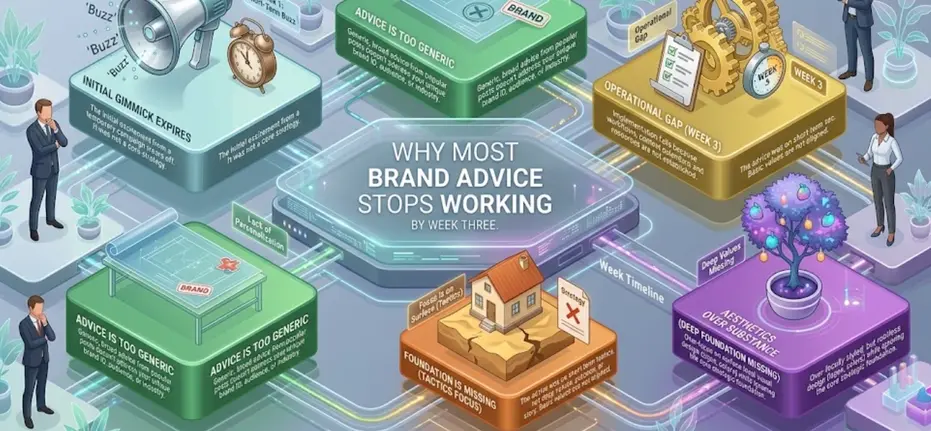
The advice that circulates most widely is not wrong, it is just written for companies that already have a functioning operation underneath it. Telling a ten-person business to “own a distinctive position” is fine, but it does nothing about the fact that their invoices go out late and their phone line goes to voicemail on Fridays. Brand work sits on top of operations. When the operation wobbles, the brand work is the first thing to fall off.
The pattern I have watched repeat, in my own business and in others I have advised, looks like this:
- Week one, everyone is energised and the new messaging goes up on the site
- Week two, the messaging meets a real customer with a real complaint
- Week three, the team quietly reverts to the old behaviour because the new promise was never resourced
- Month two, someone suggests that the problem was the messaging, and the cycle restarts
The fix is not a better brief. The fix is to make fewer promises and staff the ones you keep. Every lesson below is a version of that idea.
Lesson One, The Small Promises Are The Ones Being Tested
Customers do not audit your mission statement. They audit whether the callback came when you said it would. That is the promise that gets tested first, tested cheaply, and tested repeatedly, and it is the one most businesses treat as an operational detail rather than a brand asset.
Gallup’s research on how often companies keep their brand promises found that only about half of the customers it surveyed strongly believed the companies they buy from always keep the promises they make, while the highest performing companies in its database hit that mark around three quarters of the time. The gap between those two numbers is not a creative gap. It is a scheduling and staffing gap.
My own mistake was specific and slightly embarrassing. We advertised a five day turnaround because a competitor advertised five days. Our actual average over the following quarter was just over nine. Nobody complained loudly. They simply stopped sending the second project. When we changed the site to say “usually eight to ten working days, and we will tell you on day one if it will be longer”, enquiries dropped by roughly a fifth and the proportion that turned into repeat clients went up. That trade was worth making, and I would not have believed it beforehand.
| Promise Type | How Often It Is Tested | What Customers Notice When It Breaks |
|---|---|---|
| Callback or reply time | Every single enquiry | Whether you are organised enough to be worth the risk |
| Quoted turnaround | Every project | Whether your other numbers can be trusted |
| Stated price and fees | Every transaction | Whether you were being straight with them earlier |
| Stock or availability claim | Every order | Whether the website reflects reality |
| Support hours | Only when something is wrong | Whether the relationship is one sided |
The practical move is to write down every promise your business currently makes in public, including the ones buried in email signatures and old landing pages, and then measure your real performance against each one for a month. Most owners find at least two promises they have been quietly failing for years.
Lesson Two, Say The Awkward Part Before Anyone Has To Ask
There is a moment in most buying decisions where the customer is trying to work out what you are not telling them. Setup fees, minimum contracts, what happens if they cancel, who actually does the work, how long the waiting list is. If they have to hunt for it, the hunting itself becomes the memory.
This is measurable. Baymard Institute’s long running research into checkout abandonment puts the average rate around seventy percent across dozens of studies, and unexpected extra costs appearing late in the process is consistently the single largest reason shoppers walk away when they were otherwise ready to buy. The cost was not the problem. The timing of the reveal was the problem.
I sat on this lesson for far too long. We kept a setup fee off the pricing page because we were told it would reduce enquiries. It did reduce enquiries. It also produced a run of calls that ended with a version of “you should have said that earlier”, and those people did not come back, and some of them told other people. The fee stayed the same when we finally published it. What changed was that the conversation started from a place of agreement rather than correction.
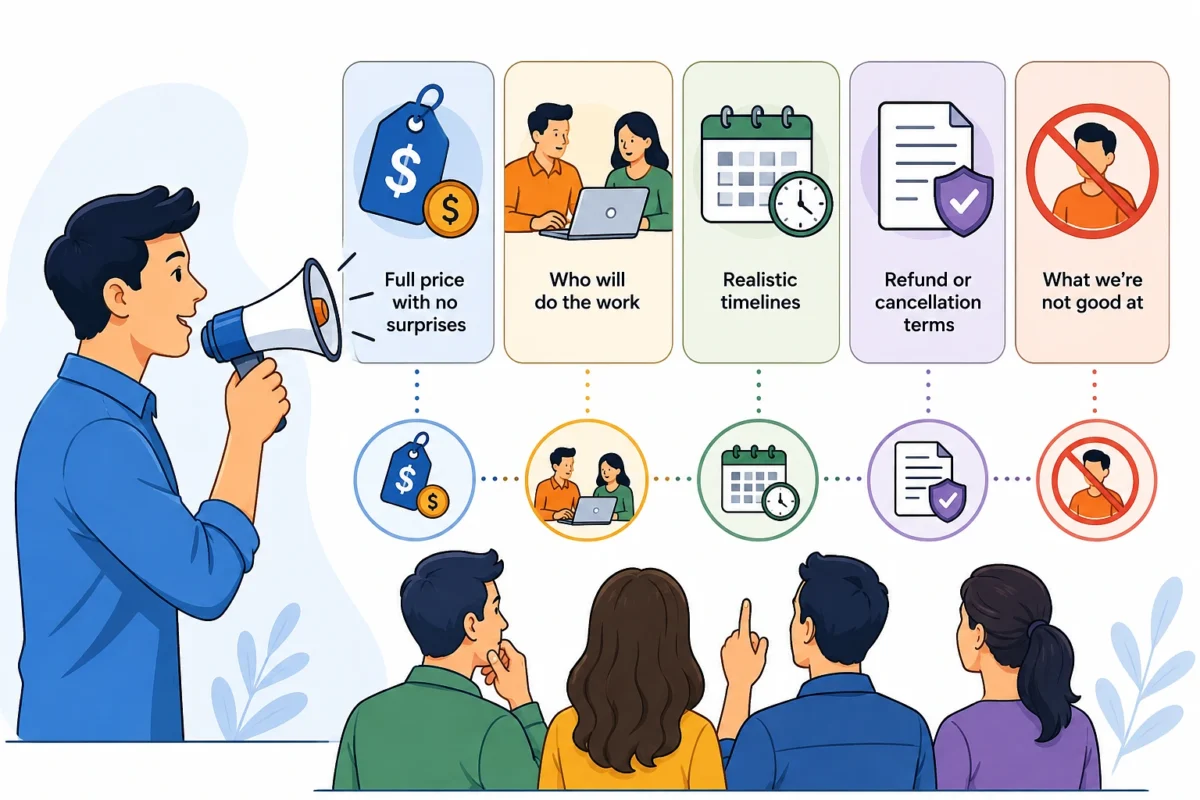
Things worth stating before you are asked:
- The full price including anything that is not optional
- Who will actually be doing the work, and whether any of it is subcontracted
- Realistic timelines rather than best case timelines
- What your refund or cancellation terms are, in plain sentences
- What you are not good at, and who you would send that work to instead
That last one sounds like commercial self harm and it is not. Turning away two badly fitting enquiries a month has been the cheapest reputation work I have ever done, because those people remember being sent somewhere better and they say so.
Lesson Three, People Trust People, And A Logo Is Not A Person
Brand affection almost never attaches to a mark. It attaches to a person, a voice, a recurring face, or a piece of writing that clearly came from a human being with a point of view. This is why founder led businesses often punch above their weight, and why they stall when the founder disappears behind a communications team.
The usability research here is stable and older than most of the tactics people sell. Nielsen Norman Group’s usability testing on the four credibility factors that make a website look trustworthy found that the things people use to judge trustworthiness have barely changed in decades: the quality of the design, whether you are upfront with information, whether the content is thorough and current, and whether you are connected to the rest of the web rather than sitting in a sealed box. That last factor is the one small businesses neglect. A site with no external footprint, no third party reviews, and no traceable people reads as provisional, regardless of how good the design is.
What this looks like in practice, in rough order of effort:
- Real names and real photographs on the about page, with actual roles rather than invented titles
- A visible physical address and a phone number that a human answers
- Bylines on anything you publish, so a reader can see who is accountable for a claim
- Photographs of the work happening, not only the finished result
- Presence on the review platforms your customers already use, including the ones you cannot control
We resisted the last point for a year because we were frightened of a bad review. When we finally listed, the first review was three stars and mentioned a communication failure that was entirely fair. Answering it honestly on a public page did more for us than the eleven positive reviews that followed. Prospects mentioned it in sales calls. Several said it was the reason they got in touch.
Lesson Four, The Apology Is Part Of The Product
Every business fails its customers. The variable is not whether it happens, it is what the customer sees afterwards. A failure handled well can leave someone more attached to you than they were before, and a failure handled defensively will erase a year of good work in about four minutes.
The pattern that has worked for me is unromantic and repeatable. Say what happened, say why, say what you are doing about it, say what the customer gets, and do not attach conditions. The most common error is bundling an apology with an explanation of why it was partly the customer’s fault. That sentence never lands the way the writer thinks it does.
| Stage | What Weak Recovery Looks Like | What Strong Recovery Looks Like |
|---|---|---|
| First contact | Delayed while you work out fault | Within hours, before you have all the answers |
| Explanation | Vague, passive, blames a system | Specific, names the decision that went wrong |
| Remedy | Discount on future work | Fixes the current problem first, then discusses money |
| Follow up | None | A check back once the fix has had time to hold |
| Internal change | Nothing visible | A stated change the customer can see next time |
The hardest part is speed. We once spent six days assembling a complete account of a missed deadline before contacting the client, because we wanted to be accurate. The accuracy was worthless by then. A two sentence message on day one saying “we have missed this, here is what we know so far, I will update you tomorrow” would have held the relationship. It did not, and we lost the account.
There is a second layer to this that is easy to miss. Complaints are the cheapest research you will ever get. Log them somewhere structured, tag them, and read the tags every quarter. Three unrelated complaints about the same handover step is not three problems, it is one process defect wearing a disguise.
Lesson Five, Consistency Over A Long Window Beats Cleverness In A Quarter
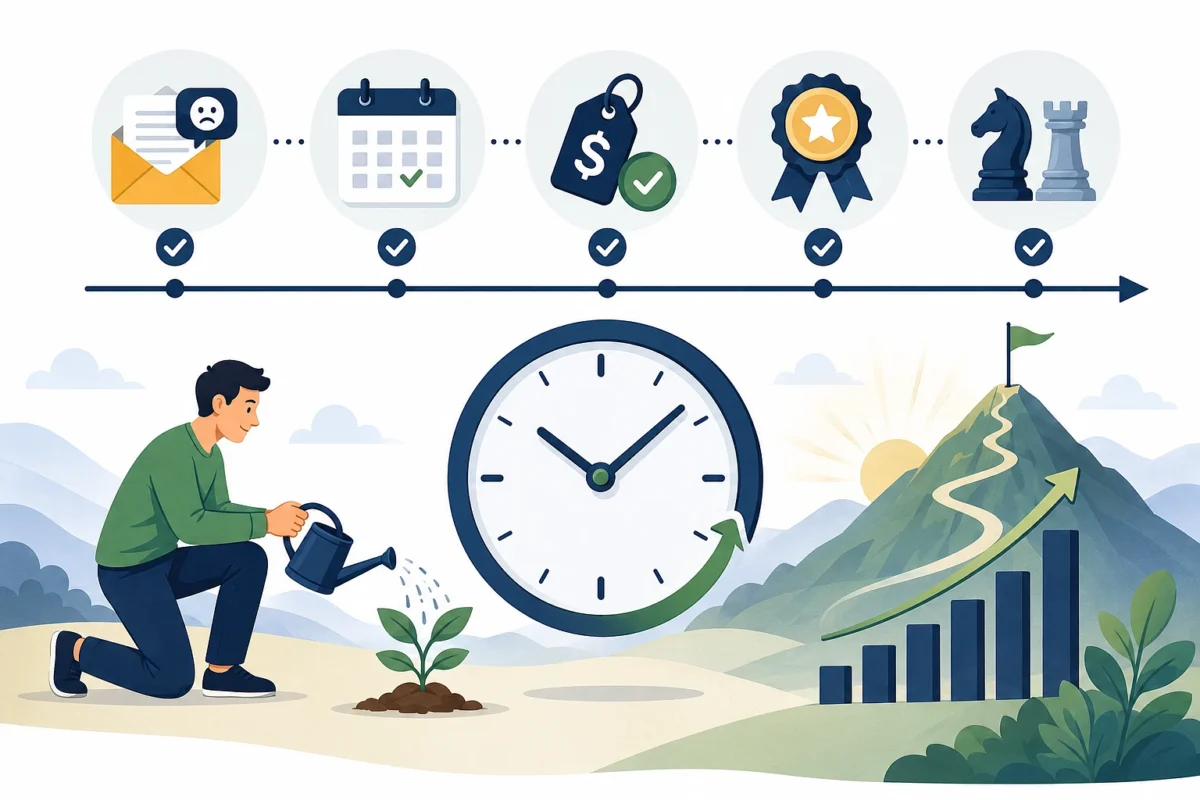
Trust is a function of prediction. Someone trusts you when they can guess, with reasonable confidence, how you will behave in a situation they have not yet seen. That confidence is built by repetition, and repetition is boring, which is why it is undersupplied.
The 2026 Edelman Trust Barometer special report on brand growth makes a related point from the demand side, arguing that trust and relevance work together rather than separately, and that unpaid voices carry substantially more weight than paid brand messaging when people are deciding whether to believe a company. You cannot buy your way to being vouched for. You can only be the kind of business that other people find easy to vouch for, repeatedly, over a period long enough for it to become a pattern.
What consistency actually means, in things you can schedule:
- The same tone in a complaint email as in a marketing email
- Publishing on a rhythm you can sustain during a busy month, not your best month
- Pricing that does not change based on how the enquiry sounds
- The same standard of work for the smallest client as the largest
- Not changing your positioning every time a competitor changes theirs
The last point deserves a warning. Changing your positioning resets the clock on everything you have built. I have done it once and it cost roughly eighteen months of accumulated recognition. If you are going to do it, do it because the business genuinely changed, not because the market felt crowded that week.
The Mistakes I Would Warn Anyone Away From
Some of these I made. Some I watched from close range and was glad not to have made.
- Buying reviews or testimonials. Beyond the obvious dishonesty, the United States has a final rule from the Federal Trade Commission banning fake reviews and testimonials, which covers fabricated reviews, paid sentiment, undisclosed insider reviews, and the suppression of honest negative ones, with civil penalties attached for knowing violations
- Suppressing negative reviews rather than answering them, which reads exactly as badly as it is
- Writing a values page nobody in the company can recite a week later
- Rebranding to solve a retention problem that is actually a product problem
- Hiring a spokesperson before you have a spokesperson worth listening to internally
- Treating your existing customers as a solved problem while all effort goes to acquisition
- Copying the tone of a much larger competitor, which makes a small business sound rehearsed rather than reassuring
The one I regret most is the retention blindness. For about eighteen months, every meeting we held was about new enquiries. Our churn was quietly climbing the whole time, and by the time it appeared on a report it had been visible in the complaint log for two quarters.
How To Tell Whether Any Of This Is Working
Brand measurement attracts a lot of numbers that feel meaningful and are not. The useful ones tend to be slower, less flattering, and harder to screenshot.
| Signal Worth Watching | What It Tells You | Vanity Metric It Replaces |
|---|---|---|
| Share of enquiries that arrive by referral | Whether people are willing to attach their own name to yours | Follower count |
| Repeat purchase or renewal rate | Whether the second experience matched the first | Impressions |
| How often people mention you unprompted in sales calls | Whether recognition exists outside your own channels | Reach |
| Complaint resolution time and repeat complaint themes | Whether operations can support the promise | Sentiment score |
| Proportion of reviews that mention a specific person by name | Whether the human layer is landing | Star average alone |
Give any of these a twelve month window before drawing conclusions. Brand movement inside a single quarter is usually noise, and the temptation to act on noise is how businesses end up rebranding annually.
Questions Worth Asking Before You Commit Budget
If you are weighing up brand investment, these are the questions I would put to any agency, consultant, or internal hire, including a version of myself.
- Which of our current promises can we actually keep at present staffing levels
- What will we stop doing to make room for this
- What does failure look like at month six, and what will we do about it
- Who inside the business owns the promise once the external work finishes
- Are we solving a recognition problem, a trust problem, or a product problem
That last question is the one that saves the most money. Recognition problems respond to visibility work. Trust problems respond to disclosure and consistency. Product problems respond to neither, and a large amount of wasted marketing spend comes from misdiagnosing the third as the first.
Where I Would Start Tomorrow
If I had to rebuild from nothing with limited time, I would not begin with a logo, a tagline, or a content calendar. I would begin by listing every promise the business makes in public, measuring performance against each one for four weeks, cutting the promises we cannot keep, and publishing the numbers we can. Then I would put names and faces on the work, answer every review in public including the unkind ones, and hold that pattern for a year without changing it.
It is slower than a campaign and it is far less interesting to present to a board. It is also the only version I have seen work more than once.
Disclaimer: This article reflects personal operating experience and general research on brand trust. It is not legal, financial, or regulatory advice. Advertising, review, and consumer protection rules vary by country and change over time, so check the requirements that apply in your own market before making changes to pricing pages, reviews, or public claims.
References
Baymard Institute. Cart Abandonment Rate Statistics. Baymard Institute research listing, updated September 2025. https://baymard.com/research/cart-abandonment-rate
Edelman. 2026 Edelman Trust Barometer Special Report: Brand Growth in an Insular World. Edelman Trust Institute, 2026. https://www.edelman.com/trust/2026/trust-barometer/special-report-brands
Federal Trade Commission. Federal Trade Commission Announces Final Rule Banning Fake Reviews and Testimonials. Press release, 14 August 2024. https://www.ftc.gov/news-events/news/press-releases/2024/08/federal-trade-commission-announces-final-rule-banning-fake-reviews-testimonials
Gallup. O’Boyle, E. and Adkins, A. Companies Only Deliver on Their Brand Promises Half the Time. Gallup Workplace, 2018. https://www.gallup.com/workplace/236597/companies-deliver-brand-promises-half-time.aspx
Harley, A. Trustworthiness in Web Design: 4 Credibility Factors. Nielsen Norman Group, 8 May 2016. https://www.nngroup.com/articles/trustworthy-design/