
Best MMORPG Games Ever Made – Ranked After Years Of Play

The best MMORPG games ever made are World of Warcraft, Final Fantasy XIV, EVE Online, Old School RuneScape and Guild Wars 2, because each one still holds a living population, still gets meaningful updates, and still gives a brand new player something to do on day one. That last part is where most lists go wrong. Plenty of games were brilliant in their year and are now empty shells where you can walk for an hour without seeing another person, and a massively multiplayer game with nobody in it is just a slow single player game with worse combat. The ranking below is built from accounts I actually levelled, guilds I actually joined and quit, and money I actually wasted. It also includes the games I wanted to love and could not, because a list where every entry is wonderful helps nobody choose.
| Game | Best For | Cost Model | Still Busy Today |
|---|---|---|---|
| World of Warcraft | Group content and raiding | Subscription | Yes, on both modern and Classic servers |
| Final Fantasy XIV | Story above everything | Subscription with a long free trial | Yes |
| EVE Online | Risk, politics and economics | Free tier plus optional subscription | Yes, though concentrated in certain regions |
| Old School RuneScape | Slow progress, phone friendly | Free with membership | Yes |
| Guild Wars 2 | Playing whenever you feel like it | Buy the expansions, no subscription | Yes |
| The Elder Scrolls Online | Solo players who want company nearby | Buy to play with optional extras | Yes |
Why This List Ignores Review Scores
Launch reviews measure a game on its first week. An MMORPG is judged over years, and the things that matter most cannot be seen at launch: whether the community stays kind to newcomers, whether the developer keeps its promises, whether the shop creeps into the gameplay. So I scored these on things a review never covers.
| What I Measured | Why It Matters More Than A Score |
|---|---|
| How long before another player speaks to you | Predicts whether you will still be playing in a month |
| Catch up burden for a new account | Decides whether the back catalogue feels rich or hopeless |
| Whether the shop sells power or looks | Shapes every fight you have with another player |
| How the game treats a two hour week | Most adults do not have twenty spare hours |
| Whether old content stays useful | Tells you if the world is alive or a corridor |
| How the community treats mistakes | The difference between a hobby and a chore |
Notice what is missing. Graphics are near the bottom of my list, because the two games on it that I have played longest look the oldest. Systems and people age far better than textures.
The Test I Use: How Long Until Somebody Talks To You
Over a couple of years I made fresh accounts on new servers with no friends, no guild and no help, and I wrote down how long it took before another human being spoke to me without being asked first. It is a crude measure and my sample is one person with one play style, so read it as a pattern rather than a finding. It still predicted my long term interest better than anything else I tried.
| Game | Time To First Unprompted Message | What Usually Prompted It |
|---|---|---|
| Final Fantasy XIV | Under an hour | Veteran players get rewards for helping newcomers |
| Old School RuneScape | About two hours | Shared resource spots create small talk |
| World of Warcraft | Two to four hours | Group finder for a low level dungeon |
| Guild Wars 2 | Around an hour | Open world events pull strangers together |
| The Elder Scrolls Online | Several hours | Solo story design keeps people apart early |
| EVE Online | Days, or minutes if you join a corporation | Nobody speaks to you until you ask, then everyone does |
The pattern is that games which reward veterans for helping beginners produce friendly newcomers, and games that let you finish everything alone produce lonely servers. That single design choice separates the two ends of my table more cleanly than budget or age ever did.
World Of Warcraft Set The Rules That Everything Copied
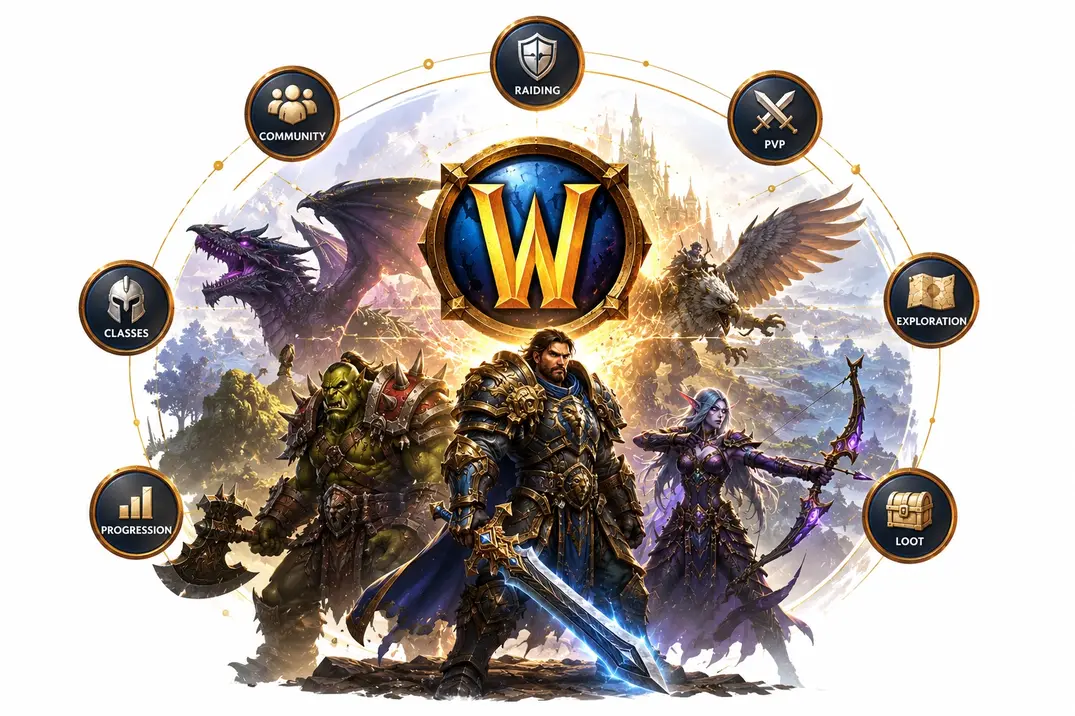
Almost every convention you take for granted in the genre was either invented or popularised here: the quest marker, the group finder, the raid lockout, the talent tree. It became the reference point so completely that other games were reviewed by how far they sat from it, and it is the only MMORPG in the inaugural class of the World Video Game Hall of Fame, with the museum’s own entry crediting it for changing how people think about online communities.
What I find interesting now is that the game solved its own biggest problem and then had to answer for it. Making group content easy to reach also made it possible to raid for years without learning anyone’s name.
| Holds Up Well | Has Not Aged Well |
|---|---|
| Combat feel and class fantasy | Levelling that races past its own story |
| Raid design at the top end | Systems bolted on and removed each expansion |
| The Classic servers for a slower version | Reliance on outside websites to play optimally |
| Sheer volume of content for a new account | A shop that sells cosmetics at odd prices |
My honest advice for a returning player is to pick the version that matches what you missed. If you miss the world, go to Classic. If you miss the fights, go to the current version. Trying to get both from one client is how people burn out in a fortnight.
Final Fantasy XIV Is The Comeback That Should Not Have Worked
The original version launched in 2010 and was bad enough that Square Enix apologised, shut it down, wrote the destruction of the world into the story, and rebuilt it as A Realm Reborn in 2013. Nothing in the industry works like that. It is the strongest evidence I know that an MMORPG can be saved by admitting a failure rather than patching around it.
The result is the only game on this list I would recommend to somebody who does not like MMORPGs, because it plays like a long single player role playing game that happens to have other people in it.
- The story is the point, and the game gates content behind it rather than around it
- The free trial covers an enormous amount of the game, so you can test it properly before paying anything
- One character can be every class, which removes the usual regret about picking wrong
- Duty finder groups are usually patient with first timers, partly because veterans are rewarded for joining them
- The early hours are slow, and anyone telling you otherwise is trying to protect the recommendation
- Raiding at the highest level is as demanding as anything in the genre, which surprises people who arrive for the story
The catch is real. There are stretches of the early story where you fetch things for people who are unpleasant, and I have watched several friends stop in exactly the same place. Push through that section and the game changes shape.
EVE Online Is An Economy Wearing A Space Game Costume
I have never had more fun losing than I did in EVE, and I have never recommended a game with more caveats. It runs as one universe rather than separate copies, so everything that happens is shared, and losses are permanent. The economy is player made to a degree that CCP has published regular economic reports about it and has employed economists to study it.
The scale that follows from that is genuinely unlike anything else. A famous 2014 fight started over an unpaid bill and became a battle lasting almost a day with dozens of the game’s largest ships destroyed, described in CCP’s own account of the Bloodbath of B-R5RB.
| What EVE Offers | What It Asks In Return |
|---|---|
| Real consequences for every decision | You will lose things you spent weeks earning |
| Politics, spying and betrayal as intended play | Some of it will feel personal |
| A skill system that trains while you are offline | Slow starts that no amount of playing speeds up |
| Groups that operate like small institutions | Scheduled operations and voice chat with strangers |
| Stories nobody else in gaming can tell | Long quiet stretches between those stories |
My guidance is blunt. Do not play EVE alone, because solo new players see a spreadsheet and quit. Join a corporation that trains newcomers in your first week or do not start at all.
Old School RuneScape Lets Its Players Vote
This one confuses people who have not played it. The game looks two decades old because it is built from a 2007 backup, brought back in 2013 after players asked for it, and it has become one of the healthiest communities in the genre. The reason is a polling system: proposed content goes to a player vote, and changes have historically needed roughly three quarters of votes in favour to pass, with the exact threshold adjusted over the years. You can see current and past polls on the official Old School RuneScape site.
- Progress is slow on purpose, which makes small achievements feel earned
- The mobile client is properly good, so short sessions actually work
- Skills matter as much as combat, and some players never fight at all
- The voting system means the community owns the game’s direction in a way that is rare
- Some skills take hundreds of hours, and the game does not pretend otherwise
- Third party gold selling and account theft are constant problems, so account security deserves real attention
I keep coming back to this one during busy periods of life, because ten minutes of progress is still progress. Very few games on this list can say that honestly.
Guild Wars 2 Proved A Subscription Is Not Required
You buy the expansions and you own them. There is no monthly fee, which changes the psychology completely, because you never feel you are wasting money by not logging in. That single decision is why it is the game I recommend most often to people with unpredictable schedules.
| Design Choice | The Effect On How You Play |
|---|---|
| No monthly fee | You return without guilt after months away |
| Events that anyone nearby joins automatically | Strangers cooperate without negotiating first |
| Top gear stays relevant across expansions | Old content does not become worthless |
| Levelling that scales you down in old zones | The whole map keeps some purpose |
| Story delivered in seasons between expansions | Missing a season leaves gaps in the plot |
The trade off is that the game is less clear about what to do next than its competitors. Players who need a checklist sometimes find the freedom unpleasant rather than freeing.
The Older Games That Built Everything Else
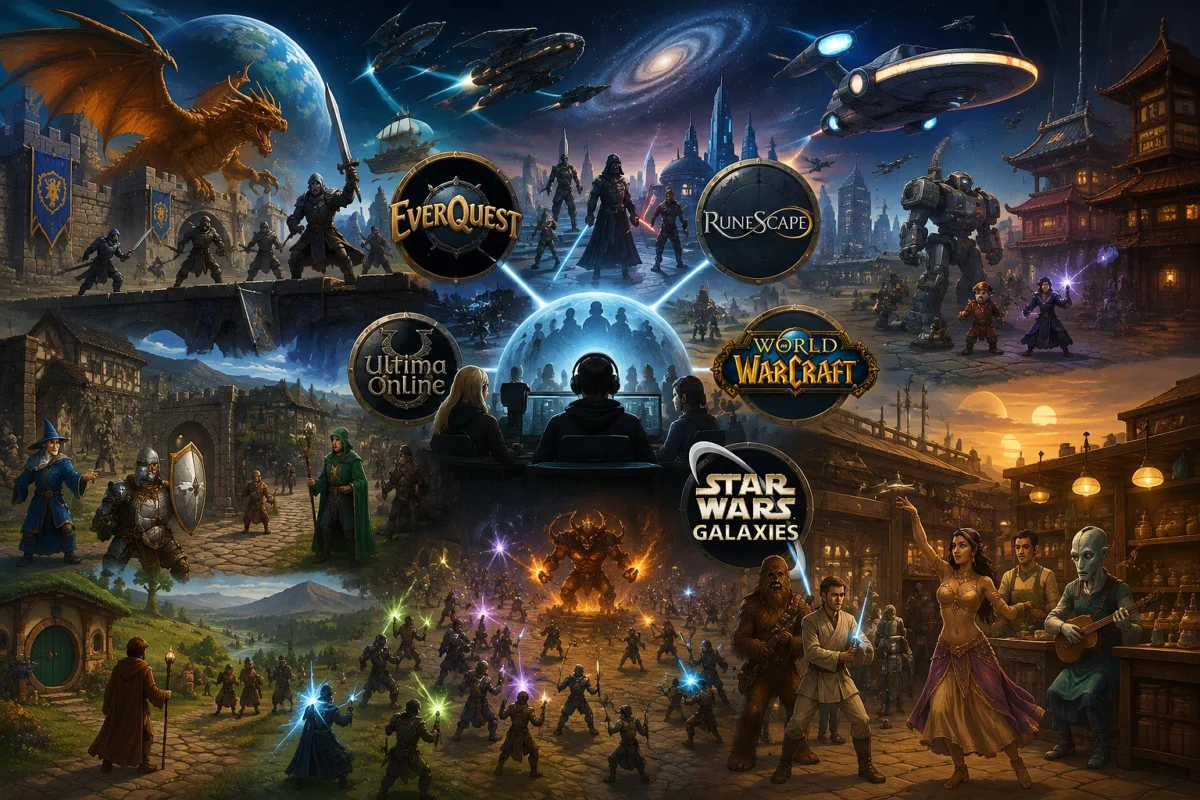
Some of these are still running, some are memories, and all of them contributed something the modern games kept.
| Game | Year | What It Contributed |
|---|---|---|
| Ultima Online | 1997 | Player housing, a real economy, and the term MMORPG itself |
| EverQuest | 1999 | Group dependency and the dungeon crawl as social event |
| Dark Age of Camelot | 2001 | Three sided realm warfare that people still copy badly |
| Final Fantasy XI | 2002 | Cross platform play and punishing group content |
| Star Wars Galaxies | 2003 | Player cities, non combat careers, and a cautionary tale |
| City of Heroes | 2004 | Character creation that has arguably never been beaten |
| Lord of the Rings Online | 2007 | Faithful world building and a player music system |
Star Wars Galaxies deserves its own note. It let you spend your entire career as a dancer, a doctor or a shopkeeper, then replaced its systems late in life with something simpler, and lost the audience that had stayed for the complexity. It closed in 2011 and people still talk about it, which tells you how much the original design meant to them.
The Ones I Wanted To Love And Could Not
Being honest about the misses is what makes the recommendations worth anything.
| Game | What Is Genuinely Good | Why I Stopped |
|---|---|---|
| Black Desert Online | The best moment to moment combat in the genre | The shop reaches into too much of the game |
| New World | A beautiful world and satisfying gathering | Content ran out and the population moved on |
| The Elder Scrolls Online | Strong writing and a huge map | Combat feels loose, and I rarely met anyone |
| Lost Ark | Excellent boss fights | Weekly obligations turned it into a second job |
| Throne and Liberty | Good large scale fights | Progress felt tied to how much I was willing to spend |
Every one of those is a good game for somebody. My reasons for leaving are personal, and I have friends who are still happily playing three of them. What I would ask you to take from the table is the shape of the failure rather than the verdict, because the same problems repeat: content that runs dry, shops that sell advantage, and schedules that punish you for having a life.
Pick By The Kind Of Player You Are
The right answer changes completely depending on what you want from an evening.
| If You Want This | Start Here |
|---|---|
| A story that makes you feel something | Final Fantasy XIV |
| Difficult group content with clear goals | World of Warcraft |
| Something to play on a phone during a commute | Old School RuneScape |
| Freedom with no monthly commitment | Guild Wars 2 |
| Consequences, politics and genuine risk | EVE Online |
| A world to wander through with a partner | Lord of the Rings Online or The Elder Scrolls Online |
| Nostalgia for how the genre used to feel | World of Warcraft Classic |
What These Games Actually Cost
The sticker price is rarely the real number. Understanding the model before you start saves a lot of irritation later, and rating boards now flag in game purchases on store listings, which is worth checking against the ESRB ratings guide before you buy anything for a younger player.
| Model | How It Feels In Practice | Watch Out For |
|---|---|---|
| Monthly subscription | Predictable, and pushes you to play to justify it | Guilt on the months you are busy |
| Buy the expansion, no fee | The friendliest model for adults | Convenience items sold separately |
| Free with membership tiers | Generous, with a clear line between tiers | Slow progress designed to sell the upgrade |
| Free with a heavy shop | Costs nothing until it costs a lot | Advantages sold rather than appearances |
My rule after years of this is simple. Work out what the game sells before you work out whether the game is fun, because a shop that sells power will eventually decide how the game plays whether you buy anything or not.
The Time Cost That Reviews Leave Out
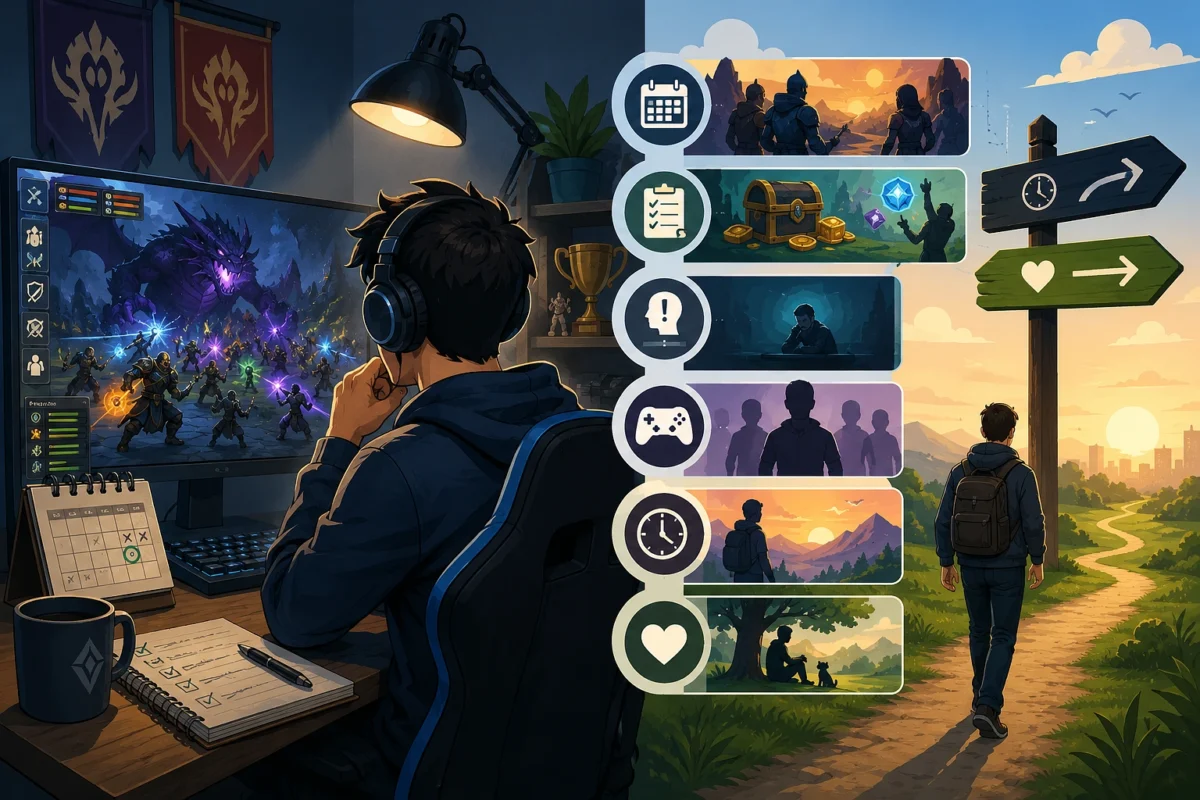
These games are built to be habits, and that is a compliment and a warning at once. Daily tasks, weekly resets and raid schedules are all designed to bring you back on a rhythm. For most people that is harmless and pleasant. For some it stops being a choice, and the World Health Organization now recognises gaming disorder as a condition when play takes priority over other parts of life for a sustained period, which WHO explains in its own questions and answers on the subject.
- Decide your raid nights before you join a guild, not after they need you
- Treat daily tasks as optional, since almost none of them matter over a year
- Notice when logging in feels like an obligation rather than a plan
- Keep one game as the main one, because two schedules become a workload
- Take breaks between expansions instead of playing through the quiet stretches
- If a game only feels good when you are ahead of other people, that is a signal worth listening to
I have quit two guilds over scheduling and I do not regret either. A hobby that starts issuing rotas has stopped being a hobby.
Mistakes I Made That You Can Skip
- Chasing the newest launch every year instead of going deeper into one game
- Buying convenience items early, before I knew whether I would stay
- Joining the biggest guild I could find rather than the friendliest one
- Following optimisation guides so closely that I stopped making my own decisions
- Ignoring a game because it looked dated, which cost me years of Old School RuneScape
- Levelling a second character before finishing anything on the first
Questions People Ask Me Most
Which one should a complete beginner start with? Final Fantasy XIV, because the trial is long enough to be a real test and the game teaches its systems patiently.
Is it too late to start an old game? No. Older games have more content and cheaper entry, and the catch up systems in the big titles are generous now.
Do I need a guild? For World of Warcraft and EVE, effectively yes. For Guild Wars 2 and Old School RuneScape, no, though you will have more fun with one.
Are subscriptions worth it? If you play more than a few hours a week, a subscription is usually cheaper than the shop driven alternative.
What about newer releases? Give any new MMORPG six months before you commit. The genre’s history is full of strong launches that emptied out by spring.
A Closing Word
The best MMORPG games ever made are not the ones with the highest scores or the biggest budgets. They are the ones that were still worth logging into five years after everyone stopped writing about them, and that survived because the people running them kept listening. Pick the one that matches the life you actually have, not the one that matches the player you wish you were. The game will still be there in a year, and so, if you choose well, will the people you met in it.