
Customer Programing Software-ham2000 | Guides Free Download


The first radio I ever tried to program by hand took me an entire Saturday evening, and by the end of it I had two working channels, one channel that transmitted on the wrong offset, and a very tired thumb. Somewhere around the fortieth button press I did what most people do, which is put the handset down and start searching for the software that was supposed to make this painless. That search is how I ended up on a dozen pages about customer programing software-ham2000, and it is also how I learned that a keyword can be popular long before anyone bothers to check whether the pages behind it agree with each other.
This guide is written from the bench, not from a product brochure. I have programmed handhelds for a small club, for a community event radio pool, and for my own shelf full of cheap Chinese portables that were bought mostly out of curiosity. I have also bricked one of them. What follows is what I wish somebody had told me before I started clicking download buttons, along with the checks I now run every single time, and a fair look at where free tools stop being enough.
What The Name Actually Points To
Here is the part nobody says out loud. “Customer programming software” is not a brand. It is a phrase borrowed from the land mobile radio trade, where manufacturers ship a Windows application that a dealer or an end customer uses to load settings into a radio. Motorola made the abbreviation CPS common, and the habit stuck, so now almost any radio configuration tool gets called customer programming software regardless of who made it.
The “HAM2000” half is where things get murky. If you read several of the pages that rank for customer programing software-ham2000, you will notice they do not describe the same thing. One page treats it as a codeplug editor for digital radios. Another treats it as a general amateur logging and rig control package. At least one describes it as an amplifier, which is a piece of hardware and not software at all. When sources this basic contradict each other, the honest conclusion is that the name is functioning as a search label rather than a single verified product with a single official homepage.
That does not make your search pointless. It just means you should read the term as a category and then match your actual radio to an actual tool. Below is the sorting I use when a name comes up that I cannot pin down.
| What You Are Looking At | How To Tell | What To Do Next |
|---|---|---|
| A manufacturer tool | Named after the radio brand or model series, hosted on the brand’s own support page | Use it, and match the version to your radio’s firmware |
| A community tool | Open source, public issue tracker, a wiki, a visible list of supported models | Check that your exact model appears on the supported list |
| A repackaged bundle | Generic name, no company address, no changelog, hosted on a file locker | Treat with suspicion until you can verify the origin |
| A hardware product | Described with watts, connectors or dimensions rather than menus | Not software, so no download will help you |
The practical version of that table is short. Find the maker of your radio, find the exact model number printed under the battery, and search for that instead of a generic bundle name. Model numbers are boring and specific, which is exactly why they work.
The Evening I Wasted By Skipping The Boring Step
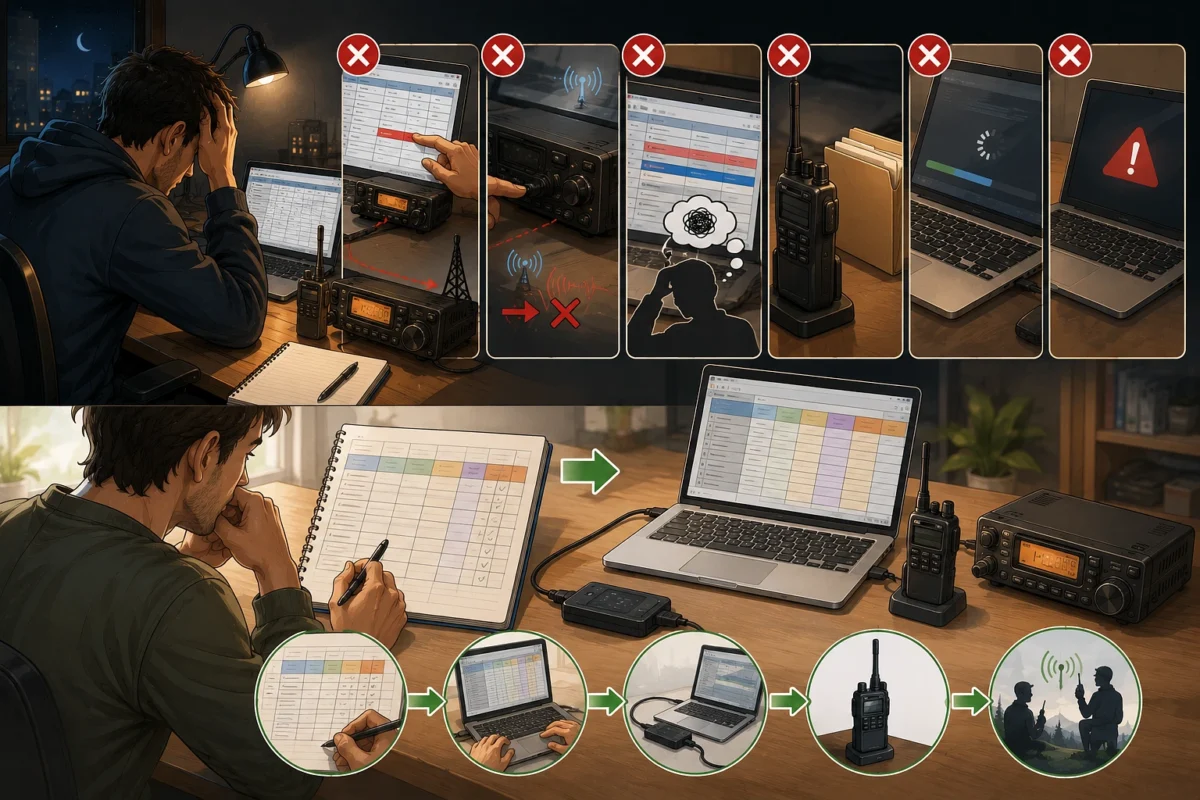
My first mistake was assuming that programming software is the hard part. It is not. The hard part is knowing what you want in each channel before you open anything, and I did not, so I filled in fields as I went and produced a file that was internally inconsistent.
These are the specific errors from that session, kept in the order I made them because the order matters more than the list:
- I typed a repeater output frequency into the receive box and then forgot to set the offset direction, so the radio listened correctly and transmitted into empty air
- I set a tone on transmit but not on receive, then spent twenty minutes convinced the repeater was down
- I used the same channel name twice with different settings, which later made the fault impossible to trace
- I never saved a copy of the factory settings, so I had nothing to fall back to
- I upgraded the software mid-session because a pop up suggested it, and the new version could not read the file I had just made
Only one of those was a software problem. The rest were planning problems wearing a software costume. My working rule since then is that a channel plan gets written down in a spreadsheet first, with a column for receive, transmit, tone in, tone out, power level and a plain English name, and the software becomes nothing more than a way to type that spreadsheet into a radio.
Why “Free Download” Pages Deserve More Suspicion Than They Get
Search intent for this keyword is heavily weighted toward a free download, so let me be direct about the risk, because it is the part that gets glossed over most often. Radio programming tools are an unusually attractive target for bundling unwanted software. They are Windows executables, they are often expected to install a driver, they ask for permissions that would look alarming in any other context, and their users are conditioned to click through warnings because the legitimate tools also trigger warnings.
I have personally downloaded a programming package that arrived as a password protected archive with the password published in a blog comment. That is a known technique for getting past scanning, and the general advice on checking software origin before installing it is worth reading in full on the CISA guidance for safer software habits, which is written for ordinary users rather than security specialists. I deleted that archive. I have no idea whether it was harmful, and that is exactly the point, because I could not tell and neither could anyone commenting under it.
| Warning Sign | Why It Matters | Safer Alternative |
|---|---|---|
| Password protected archive | Prevents scanning before you open it | Look for a plain installer from a named source |
| No version number or changelog | You cannot match the tool to your firmware | Prefer tools that publish release notes |
| Download hosted on a file locker | No accountability, files get swapped silently | Manufacturer support page or project repository |
| Installer wants to disable your antivirus | Legitimate tools do not require this | Stop, and find another source |
| Site copy that cannot describe the product consistently | Suggests the page was written to rank, not to help | Cross check against a hobby forum thread |
The most useful habit I picked up is to search for the file name alongside the word “forum” before running anything. Radio hobbyists are talkative and unforgiving. If a package has been reported as dirty, somebody has almost certainly said so in public.
The Codeplug Is The Real Product
Every serious operator I know talks about the codeplug rather than the software. A codeplug is the configuration file that holds your channels, zones, contact lists, power settings, scan lists and menu restrictions. The software is a means of editing that file. If you understand that, a lot of confusion clears up, including why version mismatches are so painful.
A few things about codeplugs that I did not appreciate at the start:
- Codeplug formats are usually tied to both the software version and the radio firmware version, so a file written by a newer tool may not load into an older radio
- Reading the radio before you write to it gives you a baseline copy, and that copy has saved me more times than any other habit
- Naming files with the date and radio serial makes it possible to work out later which file went into which handset
- A codeplug you share with a club member may carry your personal identity numbers, so check before sending
- Some radios keep a separate calibration area that programming software should never touch, which is why “flash the whole thing” advice is dangerous
The workflow I now use has no clever tricks in it. Read the radio, save that read as a backup with today’s date, make one change, write it back, test on air, then save again as a new file. Making one change at a time feels slow for about a week and then feels obvious forever, because when something breaks you know precisely what broke it.
Cables And Drivers Cause More Failures Than Software Does
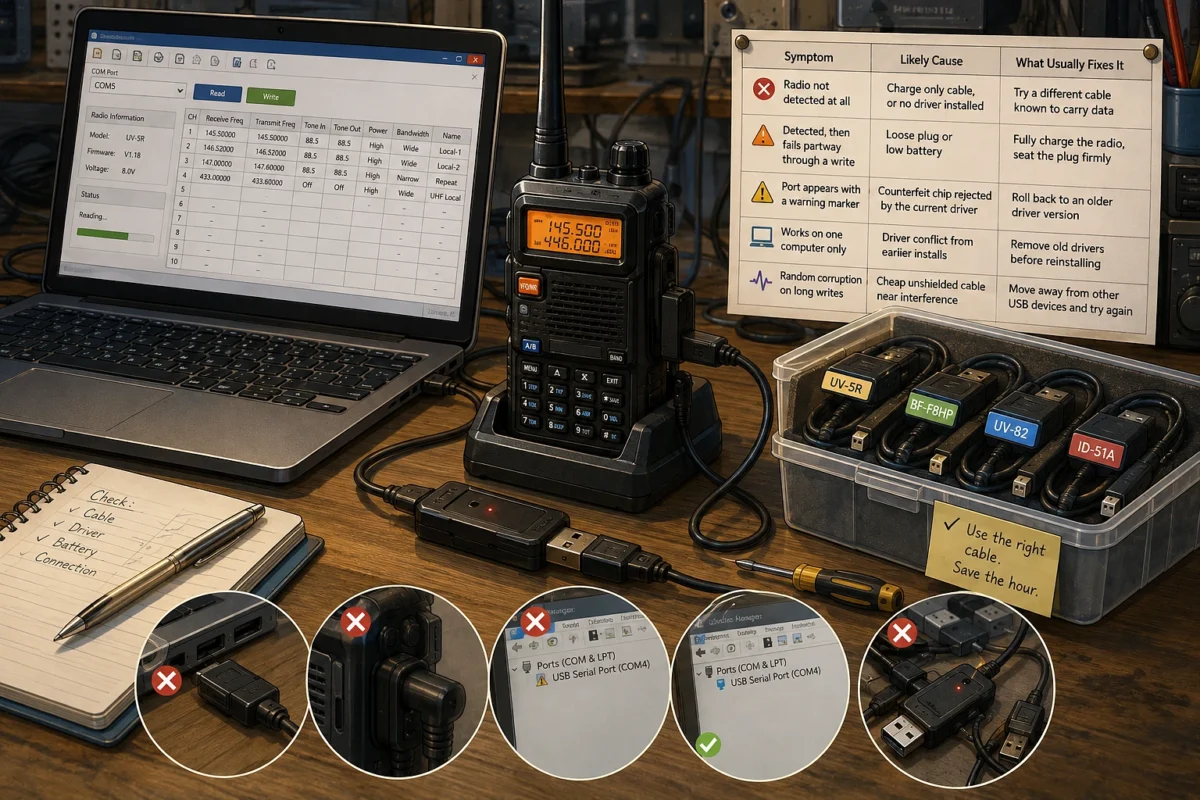
If I kept a tally of every problem people bring me at the club, the cable would win by a wide margin. The programming cable for most affordable radios contains a serial to USB chip, and the market is full of counterfeit chips that either refuse to work with current drivers or install and then behave unpredictably. A cable that worked last year can stop working after a routine Windows update, which makes people think the software has broken.
| Symptom | Likely Cause | What Usually Fixes It |
|---|---|---|
| Radio not detected at all | Charge only cable, or no driver installed | Try a different cable known to carry data |
| Detected, then fails partway through a write | Loose plug or low battery | Fully charge the radio, seat the plug firmly |
| Port appears with a warning marker | Counterfeit chip rejected by the current driver | Roll back to an older driver version |
| Works on one computer only | Driver conflict from earlier installs | Remove old drivers before reinstalling |
| Random corruption on long writes | Cheap unshielded cable near interference | Move away from other USB devices and try again |
The single cheapest insurance is to buy the cable from the same supplier as the radio, keep it in the box with that radio, and label it. I now have four labelled cables and zero arguments about which one belongs to which handset. My friend Dave, a retired dispatch technician who has forgotten more about this than I will learn, put it plainly one evening when I complained about a failed write. His view was that the software is almost never the fault, the connection almost always is, and that anyone who reaches for a reinstall before checking the plug is going to waste an hour proving him right.
What My Own Notes Show After A Year Of Club Sessions
I want to be careful here, because this is not a study. It is a tally I kept in a notebook across our club’s programming evenings over roughly a year, covering somewhere near sixty handsets, mostly budget models with a handful of mid range units. The sample is small and it is drawn from one club, so treat it as a pattern rather than a statistic.
| Problem Reported | How Often It Came Up | What It Actually Was |
|---|---|---|
| “The software does not work” | Most common complaint | Cable or driver in the large majority of cases |
| “The radio will not transmit” | Second most common | Missing tone or wrong offset, not a hardware fault |
| “The file will not open” | Regular | Version mismatch between tool and radio |
| “It worked and now it does not” | Occasional | A firmware update applied without a fresh backup |
| Genuine software bug | Rare | Two cases, both fixed by using a different release |
The lesson I took from my own tally is uncomfortable for anyone hoping a download will solve their problem. The tool is rarely the bottleneck. Preparation, cabling and version discipline are, and none of those are things a download page can sell you.
Free Tools Versus Paid Tools, Judged Honestly
This is where the commercial question sits, so I will answer it the way I answer it for club members. There is a well established free and open source option in the CHIRP project, which supports a long list of radio models and lets you move channel lists between different radios. There are also paid tools sold per radio family, and there are manufacturer tools that are usually free but often clumsy.
| Consideration | Free And Open Source | Paid Third Party | Manufacturer Tool |
|---|---|---|---|
| Cost | None | Per radio family, modest | Usually none |
| Model coverage | Wide, community driven | Narrow but deep | Only that brand |
| Moving lists between radios | Strong | Sometimes | Rarely |
| Support when stuck | Forums and issue trackers | Direct email support | Varies, often thin |
| Access to unusual settings | Sometimes limited | Often complete | Complete |
| Risk of a bad download | Low if taken from the project site | Low | Low |
My own split is simple. If I am loading a straightforward channel list into an analogue handheld, the free route is fine and often faster because I can import a list I already own. If I am setting up a digital radio with contact lists and talkgroups, or a radio where an obscure menu setting matters, I will pay for the tool that exposes everything, because an evening of my time is worth more than the licence. Nobody needs to buy anything to get started, which is the honest answer that download pages tend to avoid.
The Rules That Sit Behind The Frequencies
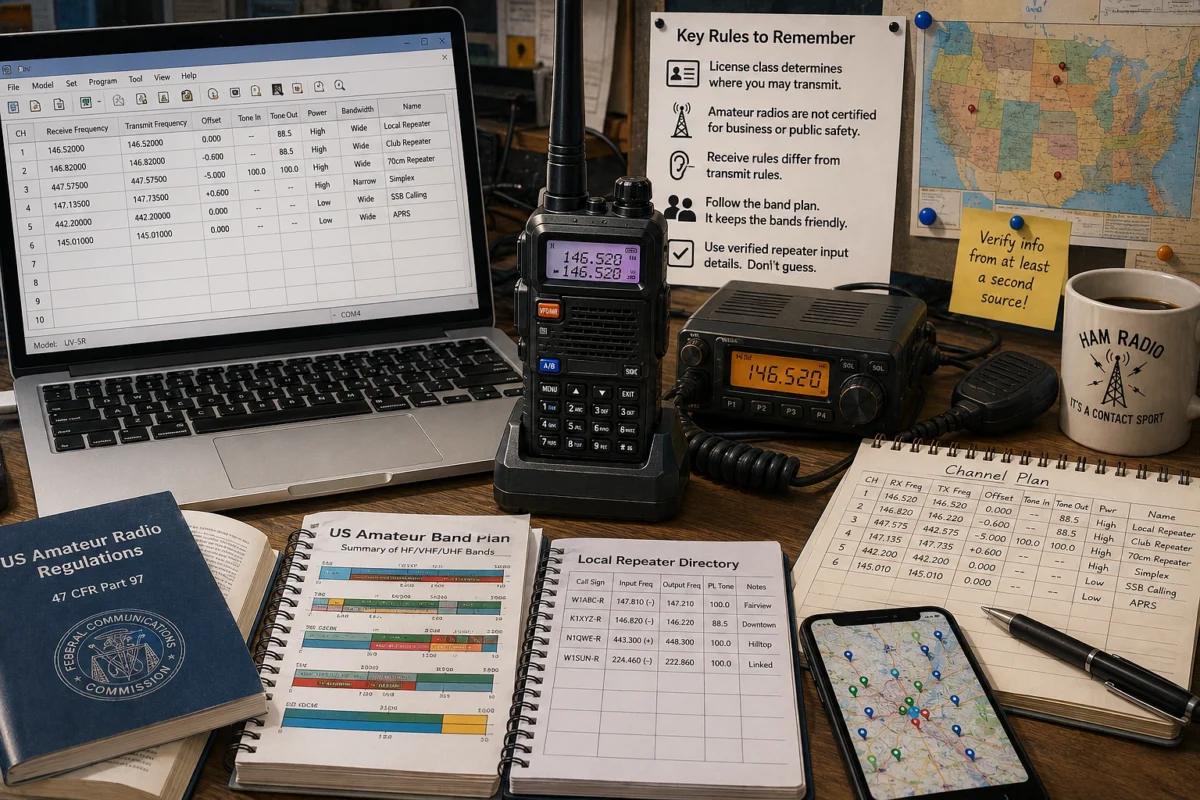
Software will happily let you type any number into a field. That does not make the number legal to transmit on. In the United States the amateur service operates under Part 97, and the actual text of the amateur radio rules is published in full on the eCFR, which is worth ten minutes of anyone’s time before a first programming session. Other countries have their own equivalents, so check your own regulator rather than assuming.
Points that come up constantly at our club evenings:
- Holding a licence class determines which segments you may transmit on, and the software does not check this for you
- A radio certified for amateur use is generally not certified for business or public safety frequencies, and programming those in does not make it legal
- Receiving is treated differently from transmitting in many jurisdictions, which is why scanner style lists are common but still need care
- Band plans are voluntary agreements rather than law in most places, yet ignoring them makes you unpopular very quickly, and the widely used band plan charts from the ARRL are the reference most operators reach for
- Repeater input details are published locally, and guessing them wastes everybody’s time
For finding what is actually in use near you, the crowd maintained listings on the RadioReference database are the starting point most people use, though local club sites are often more current for repeater details. Whatever source you use, verify against a second one before you commit a whole channel list to memory positions you will rely on.
Small Habits That Prevent Large Headaches
These are the things that turned programming from an ordeal into a twenty minute job for me. None of them are clever. All of them came from getting something wrong first.
| Habit | The Mistake It Prevents |
|---|---|
| Keep the factory read forever | Losing the ability to return to a known state |
| Name channels for humans, not for you at midnight | Confusion during an event when it matters |
| Put the most used channel in the first memory slot | Fumbling with the dial under pressure |
| Write down the software version next to each saved file | Files that will not open a year later |
| Charge the radio fully before any write | Interrupted writes and corrupted memory |
| Test every channel on air before you trust it | Finding a bad offset at the worst moment |
| Program one radio, verify it, then clone the rest | Repeating one error across a whole fleet |
The cloning point deserves a word. Copying a verified file across a set of identical radios is fast and reliable, but only after one unit has been tested properly on air. I once cloned an error into six handsets for a charity run and spent the morning apologising to marshals. Verify first, clone second.
When The Radio Refuses The File
Troubleshooting is mostly a process of removing variables. This is the order I work through, and it resolves nearly everything.
| Check | Reason |
|---|---|
| Battery level and plug seating | The most common cause by a distance |
| Software version against firmware version | Mismatches produce misleading error text |
| A different USB port, preferably not a hub | Hubs cause more trouble than they solve |
| A second computer if one is available | Separates a driver problem from a radio problem |
| Reading the radio rather than writing to it | If reading works, the link is fine and the file is at fault |
| A known good older file | Confirms whether your new file is the problem |
If reading succeeds and writing fails, the connection is sound and the issue lies with the file or the version pairing. That one distinction has saved me more time than any other piece of knowledge in this article.
Questions People Ask Me Most
Is there an official free download for this exact name? I have not been able to verify one, and the pages describing it do not agree on what it even is, so I would not download anything labelled only with that name. Search your radio’s model number instead and you will find a real tool with a real maintainer.
Will one tool program every radio I own? Probably not, though community tools come closest. Assume one tool per radio family until proven otherwise.
Can I skip the computer entirely? For a handful of channels, yes, front panel programming works fine and is a useful skill for field changes. For anything past about ten channels the software pays for itself in saved time.
Does newer always mean better? No. Radios and tools are paired, and a newer release can drop support for an older model. Keep the installer for the version that works with your radio.
What is the one thing worth doing tonight? Read your radio and save that file somewhere safe. It costs five minutes and it is the only step that cannot be repeated after something goes wrong.